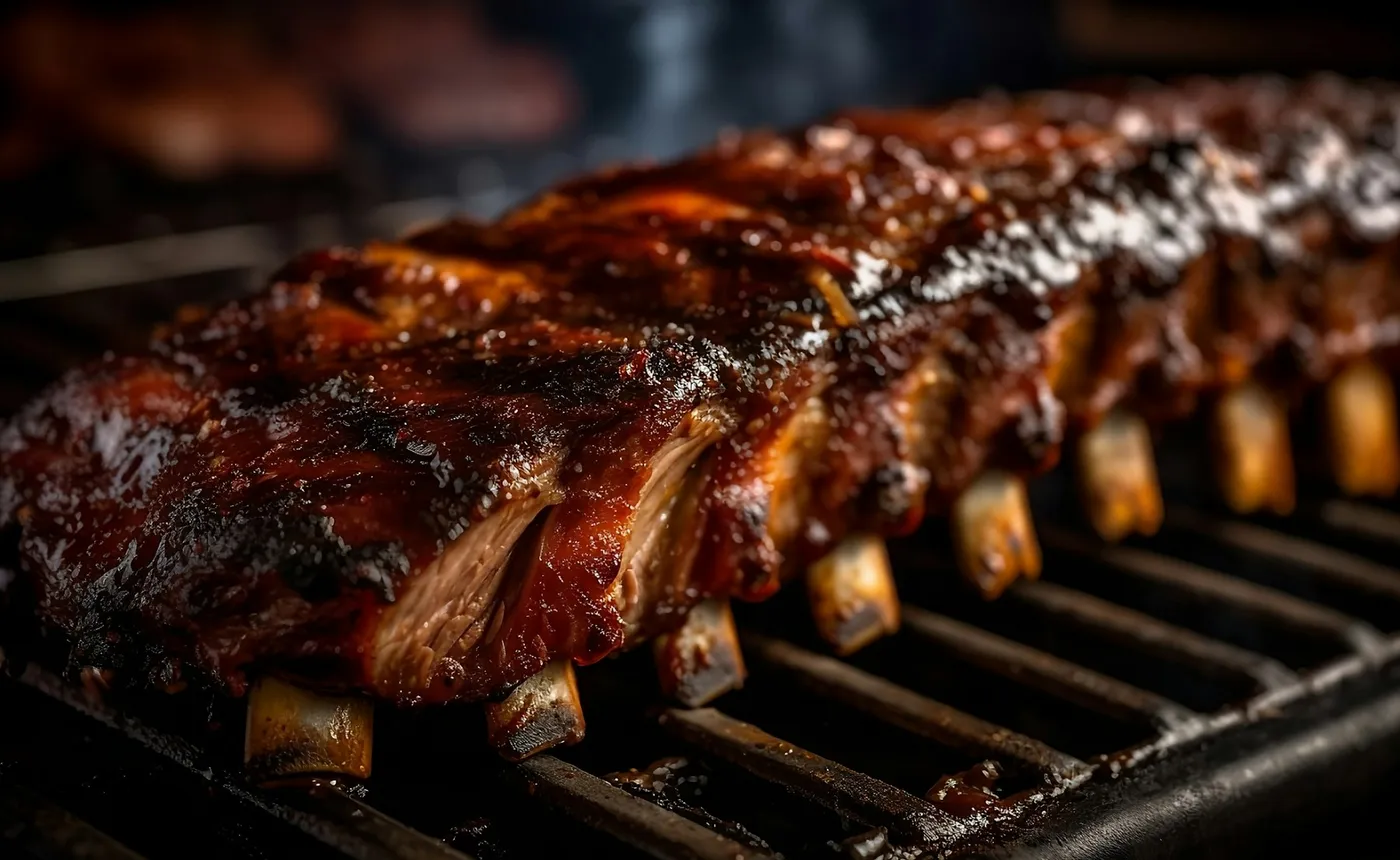
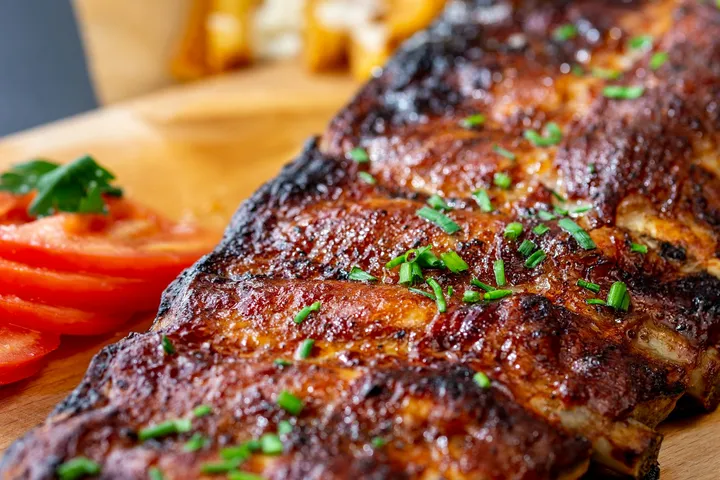
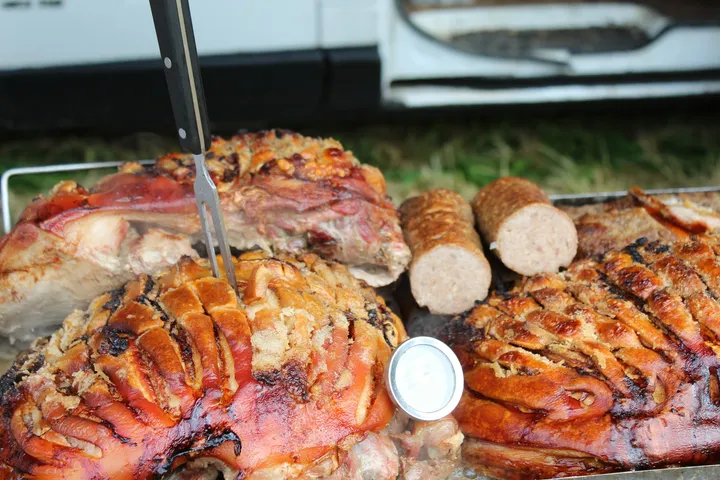
Set your pellet grill to 250°F, fill the hopper with half hickory and half cherry, and a 3 lb rack of St. Louis spare ribs is done in about 5 hours without foil. Take it off when it bends and cracks on the tongs, which usually lines up with 198 to 203°F between the bones.
This recipe is written for a Pit Boss, but any pellet grill that holds 250°F will do it. Most barrel grills run hotter at one end, on a Pit Boss usually the hopper side, and that end is where the thicker rack belongs. Out of all the pork recipes on the site, spares are the ones I’d hand a new pellet grill owner first: they’re cheap, they forgive a late start, and learning to read their bark and bend carries straight over to pulled pork.
The classic first-rack mistake is going into foil at hour two because a video said so. The rack comes out soft and grey, with half the rub left behind in the foil. Leaving it alone and misting with vinegar instead gives you real bark, and that’s the method below.
Buying ribs: St. Louis cut or whole spares
St. Louis cut spares are spare ribs with the brisket bone and the strip of cartilage cut off, which leaves a flat rectangle that cooks evenly and fits two to a grate. Look for racks around 3 lb with meat covering every bone. Pass on racks with shiners, the spots where bone shows through because the butcher cut too close, since those patches dry out and char.
Whole untrimmed spares are cheaper per pound and take ten minutes to square up yourself. Cut along the line of cartilage at the wide end until the rack is a rectangle, then put the trimmings (rib tips) on the grill beside the racks. Tips finish about an hour early, which makes them the cook’s lunch.
Read the label for “up to 12 percent solution” or “enhanced”. That’s injected salt water, and it makes the meat spongy and the rub taste too salty. Baby backs are a different, leaner cook with their own timing, so don’t swap them into this table.
How long ribs take, by rack weight
| Rack |
Grill temp |
Time |
Pull at |
| St. Louis spares, 2.5 lb |
250°F |
4 to 4.5 hours |
198 to 203°F and bends |
| St. Louis spares, 3 to 3.5 lb |
250°F |
5 to 5.5 hours |
198 to 203°F and bends |
| Untrimmed spares, 4 lb |
250°F |
5.5 to 6.5 hours |
198 to 203°F and bends |
| Spares, wrapped at hour 3 |
250°F |
4.5 hours |
203°F |
| Spares, no wrap |
225°F |
6 to 7 hours |
198 to 203°F and bends |
Those times assume the grate is holding 250°F on a day above 60°F. Cold or wind adds 30 to 60 minutes. For a weight or temperature that isn’t listed, the smoke time calculator gives a reasonable starting estimate, and the bend test still has the last word.
If you’re deciding between 225°F and 250°F, I’d run 250°F. The extra hour at 225°F buys a slightly deeper smoke flavor that most people can’t pick out on a plate, and it costs you about 2 lb more pellets.
Prep: membrane, binder and rub
Start with the membrane on the bone side. Slide a butter knife under it at one end, lift a corner, grab it with a paper towel and pull steadily. It usually comes away in one sheet; if it tears, start again from the other end. Left on, it cooks into a rubbery layer and keeps the rub off the bottom of the rack.
Pat the racks dry and spread a thin coat of yellow mustard over both sides. It acts as glue and you won’t taste it after five hours.
The rub is coarse salt, coarse pepper, paprika, brown sugar, garlic powder and onion powder. Mix it in a shaker jar and dust it on from about a foot above the meat so it lands evenly instead of in clumps. For real bark, a St. Louis rack takes around 3 tablespoons per side, with more on the meat side than the bones.
Rubbing the night before and leaving the racks uncovered in the fridge helps a little. The salt draws moisture out, dissolves into it and soaks back in, and the dry surface lets the bark set sooner. I’d call it a 10 percent improvement, which is worth it only if you remember.
Smoking the ribs, hour by hour
Load the hopper with half hickory and half cherry. Hickory carries the flavor people expect from ribs, and cherry turns the bark a deep mahogany while rounding off the smoke over a long cook. Some grills, the Pit Boss included, have a low smoke setting you can run for the first hour. I skip it, since a pellet grill at 250°F makes enough smoke for ribs on its own.
Set 250°F and give it 15 minutes with the lid shut after the controller reports it’s there. The grate always trails the display a little.
Lay the racks bone side down, meat up, with an inch or two between them and the thicker rack on the hot end. Then close the lid for two full hours. Each time you open it you lose 20 to 30°F, and the grill needs several minutes to recover.
| Time |
What you do |
What you should see |
| 0:00 |
Racks on, lid shut |
Rub looks wet |
| 2:00 |
First mist, swap racks end for end |
Color turning red-brown |
| 2:45 and 3:30 |
Mist again |
Bark darkening, still slightly tacky |
| 4:00 |
Probe and touch test |
About 190°F, bark dry to the touch |
| 4:30 to 5:30 |
Bend test, sauce if wanted |
Rack sags and cracks |
The mist is a quick, light pass of the vinegar and water, enough to dampen the surface. It slows drying before the bark sets and helps the color. It also cools the surface a touch, which adds a few minutes, and that’s fine.
Watch out: Soaking the racks every half hour instead of misting them is an easy overcorrection. The bark goes pale and soft and can take two extra hours to firm back up. If liquid is running off the rack, you’re using too much.
At hour four, push a thin probe into the meat between two bones near the middle of each rack and look for about 190°F. Then touch the bark. If rub comes off on your fingertip, the surface hasn’t set and sauce would slide off it, so give it more time.
If the bark is already very dark at this point and the meat still has a way to go, wrap the racks in butcher paper. Paper lets steam escape and keeps most of the bark. Foil holds everything in and braises the ribs. Paper-wrapped racks typically finish about an hour later.
When ribs are done: the bend test
Pick a rack up from one end with tongs, about a third of the way in. A done rack sags sharply in the middle and the bark cracks along the bend. If it stays stiff and only bows a little, give it another 30 minutes and test again.
The thermometer backs up what the bend tells you:
| Between the bones |
Texture |
| Under 195°F |
Chewy, meat clings to the bone |
| 198 to 203°F |
Bites clean off the bone with a little tug |
| 205°F and up |
Falls off the bone, bark gets soft |
You’ll also see the meat pull back from the bone ends by about half an inch. Treat that as a hint only, because a rack with thin meat at the ends shows bone early.
For sauce, brush on a thin coat in the last 20 minutes and close the lid so it tacks up. Any longer at 250°F and the sugar starts to taste burnt. I usually serve these dry, since the rub and cherry smoke carry them.
Rest the racks bone side up on a board for 15 minutes. Cutting bone side up lets you see where each bone runs, so the knife goes between them instead of through them.
Ribs in cold weather, wind and heat
A pellet grill feeds pellets based on what its sensor reads, so cold air pulled in by the fan means more pellets and wider temperature swings. On a 35°F day with wind, expect this cook to run past 6 hours and burn close to twice the pellets. In that weather, turn the back of the grill to the wind, use an insulated blanket from the accessories list if your model has one, and add an hour to the plan.
Heat goes the other way. On a 90°F day in direct sun, the same racks can finish in about 4.5 hours, and because the fire cycles less, the smoke comes out lighter. For more smoke on a hot day, run the first hour at 225°F and then go up to 250°F.
Most barrel-style pellet grills have a hot end, usually near the chimney or the hopper. Set an inexpensive oven thermometer at each end of the grate for one cook and you’ll know which end yours is and by how much.
Serving and reheating leftover ribs
Two racks feed four big eaters or six with sides. Smoked mac and cheese can share the grill for the last hour, since it also wants 250°F. Cut the ribs at the table and keep an end bone for yourself, because the ends carry the most bark.
Leftovers keep three days in the fridge. Wrap them in foil with a splash of apple juice and heat at 300°F for about 20 minutes, in the oven or on the grill. The microwave turns them to leather.
If you have room on the grate and a crowd coming, pork belly burnt ends run at the same 250°F and make a good starter while the ribs finish.
Pellets and thermometer for ribs
Half hickory and half cherry is my standard pork mix and the first one I’d try. If you’re buying one bag, make it hickory. The best pellets for smoking guide covers brands, blends and which bags are mostly oak filler.
Ribs need a thin probe, because the meat between the bones is barely an inch thick and a leave-in probe won’t stay put. Use an instant-read for the hour-four check and let the bend test make the call. The models I’d buy are in best wireless meat thermometers.