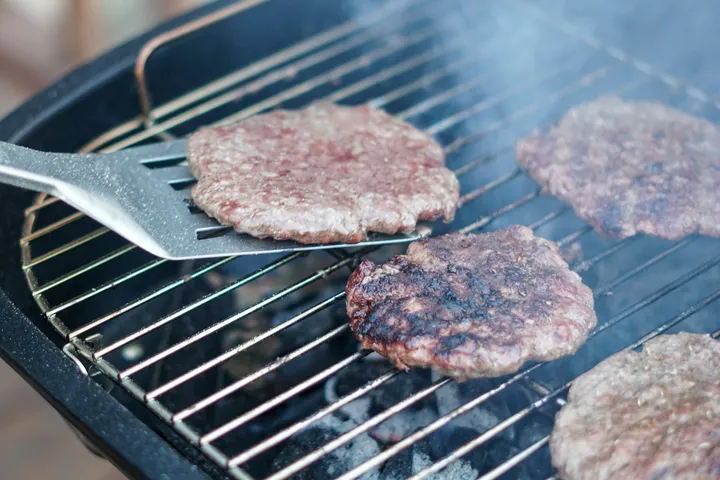
Burgers on a pellet grill
Smoke half pound patties at 225°F on hickory for 30 to 35 minutes until they read about 115°F, then sear at 450°F for 2 to 3 minutes a side to 160°F. Total time is under an hour.
- Grill
- 225°F
- Pull at
- Time
- 60 min
Traeger Ranger pellet grill review: about $480 in October 2026, 60 lb, 176 sq in, no Wi-Fi. What owners say about wind, running hot and the cooks it does well.
Reviews are built from manufacturer specs, retailer listings and the pattern of owner reports. Our hands-on cooks and temperature tests are pending, and each page will say when one has happened and on what date.
Our take
The Ranger is a proper pellet grill packed into a 60 lb latched box, and at about $480 in October 2026 nothing near its price is built as well. Owners say it runs hot and fights wind, and there's no Wi-Fi, so it suits campers and small patios cooking for two to four.
Best for
Campers, tailgaters and balcony cooks with a 120 volt outlet who want a portable that survives a truck bed and cooks for two to four.
Who should pass
Skip it if you camp without hookups or want an app; the Green Mountain Trek Prime 2.0 has Wi-Fi and a 12 volt input for about $130 less.
about $480
Price checked October 2026. Retail prices move.
Pros
Cons
If you’ll have a 120 volt outlet and a sheltered spot to cook, the Traeger Ranger is the sturdiest portable pellet grill you can buy for about $480 (traeger.com, October 2026). It weighs 60 lb, gives you 176 square inches and an 8 lb hopper, and it’s the portable owners complain about most for running hot and losing to wind. Both reputations are earned, and the rest of this page is about living with them. It tops our best portable pellet grills list, and the full-size Traegers are in our pellet grill reviews if you won’t actually be hauling it anywhere.
We haven’t cooked on a Ranger for this review. It’s based on Traeger’s product page, retailer listings and several years of owner reviews on BBQGuys, Walmart and the Traeger forums. Our own logs from a windy tailgate will go here, with a date, when they exist.
Traeger’s portable lineup has two grills. The Ranger is the tabletop box with a latched lid, and the Tailgater puts a bigger grate on folding legs. The Ranger is the one that fits in a trunk.
It makes sense if you camp with hookups, tailgate near a generator, or cook for two on a balcony. The 176 square inch grate takes four burgers, two chicken breasts and a few sausages, or a rack of ribs cut in half and stood up in a rib rack. The cast iron griddle in the box turns it into a breakfast cooker, which owners say is half the reason they bought it for camping.
It also makes sense if you want Traeger’s dealer network and parts supply in a small grill. The Digital Arc controller adjusts in 5°F steps, takes a meat probe and has Keep Warm. It’s a real pellet grill, not a novelty.
Pass on it if you need Wi-Fi, because the Ranger has never had it. Pass if you camp without power, because there’s no 12 volt input, so you’d run an inverter off the vehicle, and the 250 watt startup draw is enough to strain a small one. And pass if your usual spot is an exposed picnic table, since wind is this grill’s weakness.
From traeger.com in October 2026:
| Spec | Ranger |
|---|---|
| Price | $479.99 |
| Cooking area | 176 sq in, one grate |
| Hopper | 8 lb |
| Temperature range | Smoke setting to 450°F |
| Controller | Digital Arc, 5°F steps, one probe, Keep Warm |
| Wi-Fi | None |
| Power | 120 volt AC, 250 watts, 6 ft cord |
| Weight | 60 lb, latched lid |
| In the box | Cast iron griddle, meat probe |
| Warranty | 3 years |
Read the weight twice. Sixty pounds is “one person can lift it into a truck bed,” not “carry it down a trail.” Its nearest rival, the Green Mountain Trek, is a little heavier at 63 lb but adds Wi-Fi and a 12 volt input.
Owner reports split into two camps, and the weather is almost always the dividing line.
In calm, cool conditions, owners say the Ranger holds temperature without fuss. One reviewer cooked salmon, chicken and sausage through a season of 30 to 50°F days with no trouble. Four to six hours on a full hopper at 225°F is enough for ribs or pork tenderloin, though not a pork butt.
In wind, it’s a different grill. The box is small and thin-walled, and owners describe it losing control on an exposed table. One owner with a replacement controller still watched it climb to 450°F and fall to 135°F on a gusty day. Parking it in the lee of the truck or putting up a windbreak is the standard fix, and owners say it works.
The other repeat report is that the Ranger runs 20 to 40°F over its set point. The fire pot sits close to the grate and there’s very little air inside to buffer it. Owners handle it by setting 200°F when they want 225°F and trusting a probe at grate level more than the controller. If you don’t own a second probe, our wireless meat thermometer guide has ones that fit a small grill.
Pit tip: On a new Ranger, clip a probe to the grate for the first two cooks and note the gap from the display. Most owners find a steady offset they can dial out, and after that the grill behaves.
Smoke is Traeger’s usual light, clean profile, a bit more on the Smoke setting. Nobody calls the Ranger smoky, and the box is too cramped for a smoke tube to fit sensibly.
Searing is a griddle job. There’s no flame access, and 450°F through a diffuser won’t crust a steak. With the cast iron griddle in and 15 minutes of preheat at 450°F, burgers and thin steaks brown well. Thick steaks don’t.
Two numbers decide your trip. The 8 lb hopper gives four to six hours at 225°F, so pack a bag of pellets in a dry bin if you’ll cook more than once. The 250 watt draw is at startup, so an inverter rated well above that, on a running engine or a decent battery, is the minimum. Fuel cost is small: with bags around $0.50 to $1 a pound in October 2026 (our pellet guide has prices), a full hopper costs $4 to $8.
Build is the Ranger’s best card. The body is heavier gauge than the price suggests, the lid latches, and owners report years of truck beds and campsite tables without trouble. Rust reports are far rarer than on budget portables. The powder coat on the lid will chip if you set hot pans on it.
There’s no app and nothing to pair. The controller is a screen, a dial and a probe jack. Keep Warm is the feature worth learning, because it holds about 165°F so a tailgate batch stays ready without burning through pellets.
Watch out: Like any pellet grill, the Ranger can’t take wet pellets. Damp pellets swell and jam the auger, so cover the grill or empty the hopper before you leave it out overnight at camp.
Warranty is Traeger’s standard 3 years on defects. Owner reports on Traeger warranty service vary across the brand, and on the Ranger the pattern is that failed controllers get replaced. Keep the receipt.
About $480 at traeger.com in October 2026. Big-box listings drift between $500 and $600 depending on the month, and Traeger discounts the Ranger around holidays.
The rival that matters most is the Green Mountain Trek Prime 2.0, $349 in November 2026, with 219 square inches, a 9 lb hopper, Wi-Fi and a 12 volt DC input. If you camp without power, that input settles it. The Ranger wins on build and lid seal. The Pit Boss portables run $300 to $400 with more grate and lighter steel, and owners report wider swings. If what you really need is a small grill for a small patio, not something to carry, the Weber Smoque at about $800 cooks better and never leaves home. That category is covered in the best small pellet grills, where the Ranger also appears. The rest of the brand is in the Traeger review.
If you cook where there’s a wall outlet and you want the box to last a decade of trips, buy the Ranger and a windbreak. If you camp off grid or want to watch the cook on your phone, the Trek Prime 2.0 is the better fit for less money. If the grill will live on a balcony and never travel, skip portables altogether and look at the Smoque.
Smoke half pound patties at 225°F on hickory for 30 to 35 minutes until they read about 115°F, then sear at 450°F for 2 to 3 minutes a side to 160°F. Total time is under an hour.
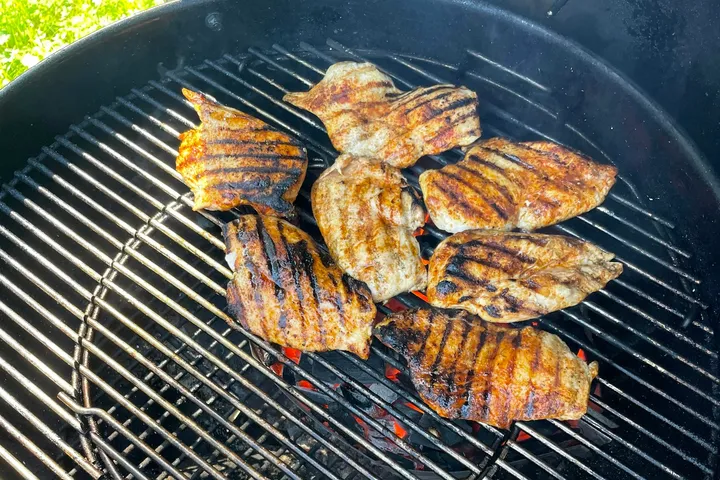
Brine the breasts for 45 minutes, then smoke them at 250°F on apple pellets for 50 to 70 minutes, about 2 hours start to finish. Pull each one at 160°F and rest it 5 to 10 minutes to reach 165°F.
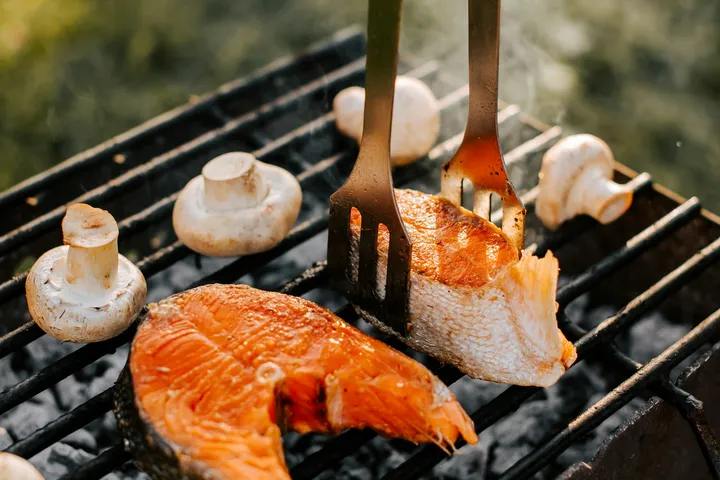
Run the grill at 225°F with alder pellets and cook the brined salmon skin side down without flipping. A 2 lb side reaches 130 to 135°F in the thickest part in about 45 to 55 minutes; pull it there.